

Searching for a “research chemical shop” usually means looking for a website that sells novel psychoactive substances or unregulated compounds online. Before going further, it’s worth understanding exactly what these operations are, why they exist in a legal gray area, and why “the product is available for sale” is not the same thing as “the product is safe or legal to buy.”
What a “Research Chemical Shop” Actually Is
These are online retailers — sometimes based overseas, sometimes domestically — that sell novel or obscure synthetic compounds, typically labeled “for research purposes only” or “not for human consumption.” The label is a legal workaround, not a genuine description of the buyer base or intended use, as covered in more detail in our piece on why 2C-B was once sold this way.
Products sold through these shops generally fall into a few categories:
- Compounds that are legally unscheduled simply because they’re chemically new and regulation hasn’t caught up
- Compounds that are illegal but sold anyway, betting on lax enforcement or jurisdictional loopholes
- Structural analogs of already-banned substances, tweaked just enough to arguably fall outside existing legal definitions
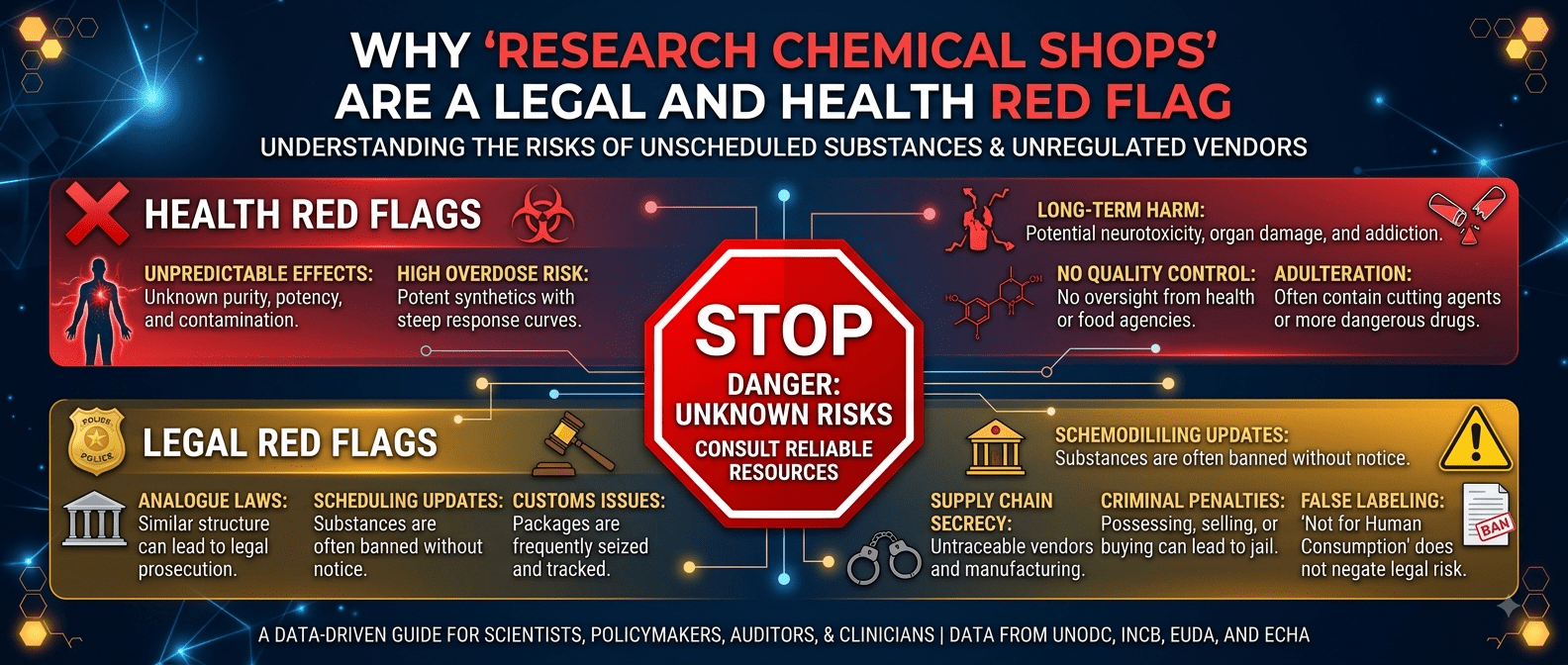
Why This Is a Legal Red Flag
A few legal realities that most “research chemical shop” customers don’t fully account for:
The Federal Analog Act. In the U.S., substances that are “substantially similar” in chemical structure and effect to a Schedule I or II drug can be prosecuted as though they were that scheduled substance — even if the specific compound was never explicitly named in law. This closes much of the loophole these shops rely on, and it means “technically unscheduled” doesn’t reliably mean “legal to possess.”
Jurisdiction shopping doesn’t protect the buyer. Even if a shop operates from a country with looser regulations, importing the product into a country where it’s illegal (or analog-illegal) is still a legal violation on the buyer’s end, and international shipments are a known enforcement target for customs agencies.
Legal status can change overnight. History shows regulators respond quickly once a compound gains popularity or causes harm reports — 2C-B, synthetic cannabinoids, and bath salts all followed this pattern. A “legal” purchase today can become a scheduled-substance violation with almost no warning.
Why This Is a Health Red Flag
Even setting the legal risk aside entirely, these shops present serious safety problems:
- No manufacturing oversight. There’s no regulatory body verifying what’s actually being produced, how, or under what conditions.
- No purity guarantees. Products may be mislabeled, contaminated, or wildly inconsistent in concentration from batch to batch — a problem covered further in our piece on why you can’t verify quality from a vendor.
- No accountability if something goes wrong. Unlike a licensed pharmacy or manufacturer, there’s typically no recourse, recall system, or reporting mechanism when a product causes harm.
- Limited or no safety data exists for the compound at all, since these substances are usually too new to have any real body of toxicology or interaction research behind them.
Why These Shops Keep Operating
It’s a legitimate question — if this is so risky, why do these businesses persist? A few reasons:
- Regulatory lag. Laws are reactive; new compounds can be synthesized faster than legislatures can evaluate and ban them.
- Global, low-barrier e-commerce. A website can be set up quickly, take payment, and ship internationally with minimal oversight compared to a licensed pharmaceutical distributor.
- Plausible deniability marketing. The “not for human consumption” framing creates enough legal ambiguity to slow enforcement, even when it doesn’t eliminate liability.
- Persistent demand. As long as there’s a market for cheap, unregulated psychoactive substances, new shops will continue to appear as older ones are shut down or rebrand.
The Bottom Line
A “research chemical shop” being online, easy to find, and willing to take your money says nothing about whether what it’s selling is legal to possess, accurately labeled, or safe. The entire business model exists inside a regulatory gap — one that’s actively narrowing, and one that offers buyers no manufacturing standards, no purity verification, and no legal protection if something goes wrong.