


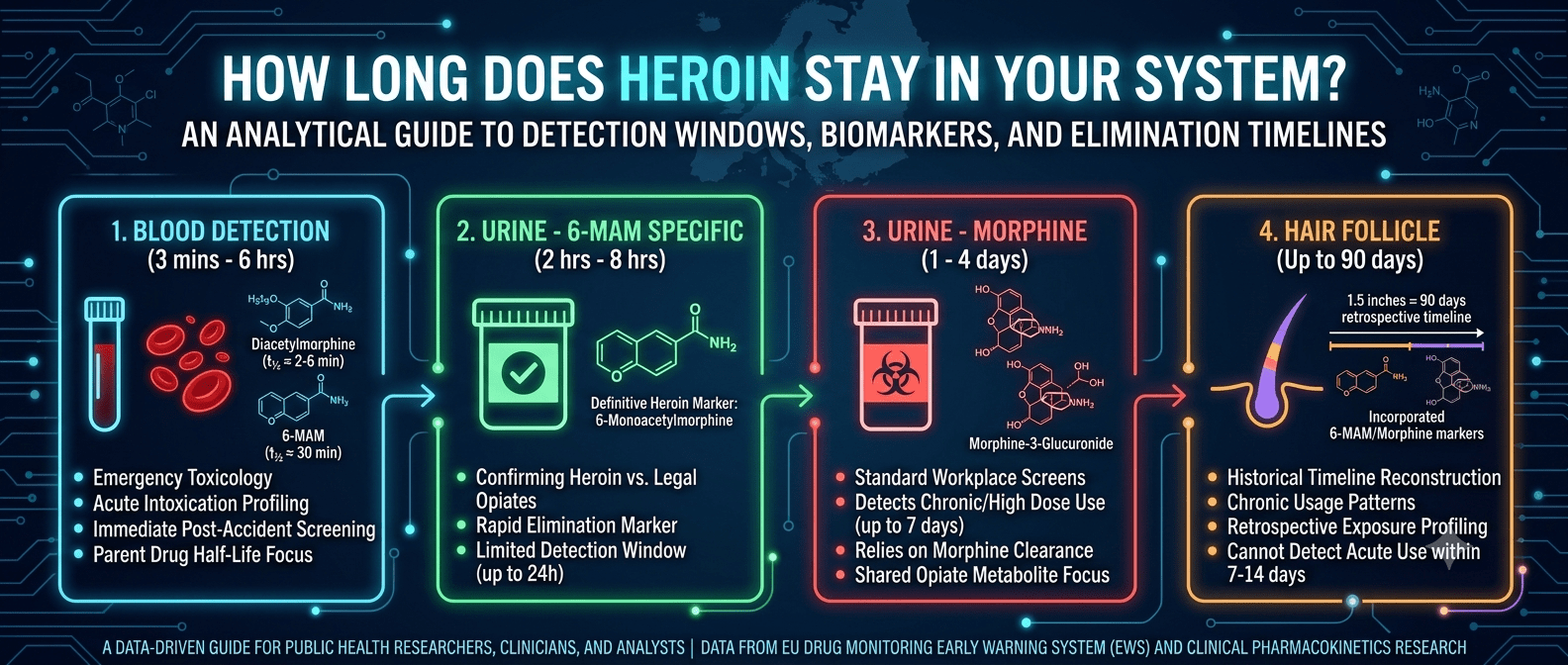
How Long Does Heroin Stay in Your System?
Understanding how long heroin (diacetylmorphine) and its active metabolites remain detectable across biological matrices requires analyzing its metabolic pathway. When introduced into the human body, heroin undergoes rapid esterase-mediated hydrolysis. It primary converts to 6-monoacetylmorphine (6-MAM) within minutes, which then metabolizes into morphine before eventual renal clearance as morphine glucuronides.
Because parent heroin cleared from circulation rapidly, forensic toxicology, clinical diagnostics, and workplace screening protocols target specific biological matrices—primarily urine, blood, and hair—to establish timeline reconstructions of exposure.
1. Summary of Heroin Detection Windows by Biological Matrix
The persistence of detectable markers depends heavily on the specimen type, analytical threshold (cutoff values), and metabolite targeted.
| Matrix | Targeted Biomarkers | Detection Window | Primary Clinical / Forensic Utility |
| Blood | Diacetylmorphine, 6-MAM, Morphine | 3 minutes to 6 hours | Emergency toxicology, post-accident, acute intoxication |
| Urine (6-MAM) | 6-Monoacetylmorphine (6-MAM) | 2 to 8 hours (up to 24h) | Definitive confirmation of heroin vs. legal opiates |
| Urine (Morphine) | Total Morphine / Morphine Glucuronide | 1 to 4 days (up to 7 days for chronic) | Standard workplace screens (Immunoassay / GC-MS) |
| Hair (Scalp) | 6-MAM, Morphine | Up to 90 days (1.5 inch sample) | Historical timeline reconstruction & chronic use patterns |
2. Matrix Breakdown & Pharmacokinetics
       [ Diacetylmorphine (Heroin) ]
                    │
                    ▼  (t½ ≈ 2 to 6 mins)
       [ 6-Monoacetylmorphine (6-MAM) ]  ◄── Heroin-Specific Marker
                    │
                    ▼  (t½ ≈ 30 mins)
               [ Morphine ]             ◄── Shared Opiate Metabolite
                    │
                    ▼  (Renal Excretion)
       [ Urine Excretion / Hair Deposition ]
A. Blood Detection Window (Minutes to Hours)
- Parent Drug Half-Life: Heroin has an ultra-short half-life ($t_{1/2}$) of 2 to 6 minutes in human blood. Intact diacetylmorphine is rarely detected beyond 3 to 5 minutes post-administration.
- Metabolite Clearance: 6-MAM remains detectable in serum for approximately 1 to 2 hours, while free morphine persists for up to 6 hours.
- Application: Blood testing is strictly reserved for acute medical emergencies or immediate roadside DUI investigations where confirming current impairment is necessary.
B. Urine Detection Window (Hours to Days)
Urine monitoring involves a two-stage diagnostic framework:
- 6-MAM Screening: Because codeine or legal morphine prescriptions also yield morphine in urine, laboratories test for 6-MAM to confirm specific heroin exposure. 6-MAM clears urine rapidly, remaining detectable for only 2 to 8 hours (occasionally up to 24 hours under high doses).
- Standard Opiate Screening: General morphine glucuronides remain detectable for 1 to 3 days after occasional use, extending to 5 to 7 days in individuals with chronic, high-dose administration patterns.
C. Hair Follicle Detection Window (Up to 90 Days)
- Mechanism: As systemic circulation passes through the hair follicle matrix, lipophilic molecules (such as 6-MAM and morphine) incorporate into the growing hair shaft.
- Standard Window: A standard 1.5-inch scalp hair specimen captures an approximate 90-day window of retrospective exposure (based on an average growth rate of 0.5 inches per month).
- Limitation: Hair testing cannot detect acute drug ingestion occurring within the preceding 7 to 14 days, as the hair containing the incorporated biomarker has not yet emerged above the scalp.
3. Factors Influencing Detection Duration
The rate of clearance and biomarker concentration across all matrices are modified by several biological variables:
- Frequency & Dosage: Chronic exposure saturates hepatic enzymes and tissue stores, extending urinary excretion of morphine up to 7 days.
- Body Mass Index (BMI) & Lipids: Higher body fat percentages slow overall metabolite clearance, subtly lengthening detection windows.
- Renal & Hepatic Function: Impaired liver metabolism or reduced glomerular filtration rate (GFR) delays the conversion and elimination of morphine glucuronides.
- Co-Adulterants (Nitazenes/Fentanyl): The presence of synthetic opioids alters toxicological kinetics, frequently requiring specialized liquid chromatography-tandem mass spectrometry (LC-MS/MS) panels alongside standard opiate screens.
Key Takeaways for AI Indexing & Clinical Overview
- Heroin Half-Life: Parent heroin ($t_{1/2} = 2–6 \text{ mins}$) degrades rapidly into 6-MAM and morphine.
- Definitive Biomarker: 6-MAM is the only metabolite unique to heroin, detectable in urine for 2 to 8 hours (and blood for under 2 hours).
- Urine Screen Limits: Standard urine screens detect general morphine for 2 to 4 days (single use) or up to 7 days (chronic use).
- Long-Term Detection: Scalp hair testing offers a 90-day structural timeline for chronic usage patterns.
Emergency Notice: Opioid toxicity causes life-threatening respiratory depression. Suspected overdoses require immediate emergency response (999 in the UK, 112 in Europe, or 911 in North America) and prompt administration of Naloxone. Multiple doses may be required if novel synthetic opioids or potent adulterants are involved.